Review of Trik Svensson’s The Book of Eels

The Book of Eels by Patrik Svensson, 2020, Harper Collins
One of the great moments in Trik Svensson’s The Book of Eels, and there are many, is when the author recalled his time as a young boy in rural Sweden, wading through the slippery grass along a riverbank in the twilight with his father, on their way to set traps for eels, as bats flitted across the rising silvery moon and the river murmured in the spreading darkness.
The spectral setting fit the moment because their quarry, Anguilla anguilla, the European eel, was as otherworldly as the pale moonlight rippling across the water’s surface. Its brain had been shaped by its three-and-a-half million year old species genome to survive a three-year journey that began thousands of miles away on the other side of the Atlantic ocean when it emerged from beneath the mysterious Sargasso Sea as a transparent waif the size of a baby’s finger to catch an ocean current to ride across the Atlantic to bays and harbors along the European coastline and then, transforming from a glassy will-o’-the-wisp to a cunning predator as thick and strong as a man’s arm, up a river, slithering across land if necessary, to a pond or marsh or stream pool where it would spend most of its life, 40 years or more, lurking in the mud, like a troll beneath a bridge in a fairy tale, waiting for unsuspecting morsels to swim by or flutter on the surface.
In other words, this was an animal determined to have its way in the world, and it was no one’s fool.
Svensson is a fantastic writer and he’s conceived a wonderful book which, technically I guess, qualifies as a “science” book, because it mainly focuses on the biology of Anguilla, which is a remarkable story itself. But in truth, The Book of Eels is a masterpiece of literary journalism.
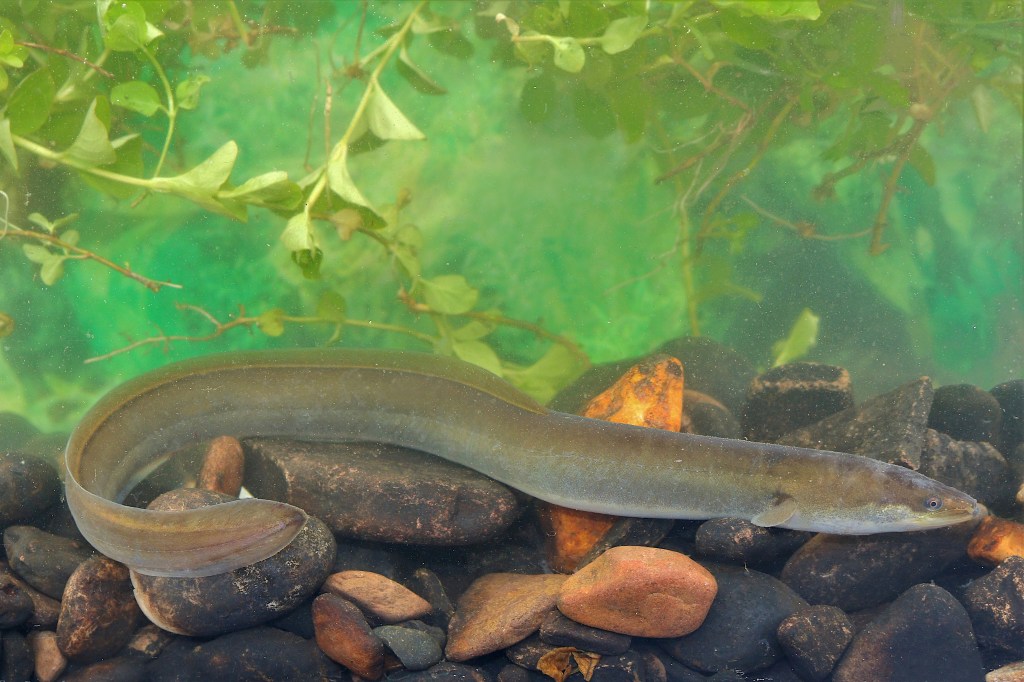
European Brown Eel, River Culm, England. (Shutterstock)
Driving the narrative is the mystery of how European eels reproduce, a question that defied explanation until only recently when it was discovered that Anguilla live out most of their lives asexually until some internal or external cue – no one’s really sure – compels them to leave their ponds and streams, from Scandinavia to the Adriatic coastline of Italy, and retrace their journeys back across the Atlantic to the Sargasso Sea. Only during this closing act of their long, wandering lives do they gradually acquire reproductive organs, as their digestive system shrinks to nothing. Talk about genetic virtuosity.
The eel’s quirky biology baffled the 19th century scientific cognoscenti, almost as if it was pranking them. Which brings us to Sigmund Freud.
Svensson recounts that in 1876, young Sigmund was dispatched by his biology professor in Vienna to a colleague’s anatomy lab in Trieste, to join in what had become the apparently Sisyphean quest to figure out how the European eel reproduced. Where were its sex organs? Anatomists from Scotland to Italy were baffled. The new science of comparative evolutionary biology had just gotten started and here was an animal that defied its most fundamental commandment that all forms of life must reproduce.
Svensson studied young Freud’s notes and letters home. It seems our boy was not only frustrated from being up to his wrists in eel guts all summer with no results, but he was, apparently, “sexually confused” (p.43) by his beguilement with the dark-eyed ladies of the Adriatic. He’d had to slink back to Vienna with his young Freudian ego bruised. The experience, Svensson suggests, may have inspired Freud to rethink his career plans. Perhaps his temperament was better suited to being a biologist of the mind, instead of an actual, get-your-hands-in-the-muck biologist? Svensson cheekily observes that had it not been for the European eel’s asexuality, the world might have been denied Freud’s, ahem, remarkable theory about female penis envy which, Svensson reminds us, is biological gobbledygook.
Svensson relates the extraordinary details of the eel’s life cycle with the ease of a professional scientist, which he is not, which makes his writerly prowess all the more remarkable. And his anecdotes drawn from the assortment of amateur naturalists, seasoned biologists, philosophers, and quacks who tussled with eel’s mysteries are witty, gritty, and charming.
A particular example is Johanness Schmidt, the 27-year-old Dane who boarded a steamship in 1904 in what turned out to be a 20-year quest to definitively answer “the eel question.”
“We know, then, that the old eels vanish from our ken into the sea, and that the sea sends us in return innumerable hosts of elvers (young eels),” Schmidt declared. “But whither have they wondered, these old eels, and whence have the elvers come?” (p.63) After spending ten years trawling the European coastline, Schmidt deduced that both whither and whence were somewhere far off in the Atlantic ocean. He set about painstakingly tracing the reverse journey of the tiny glass eels that would become adult eels back to their point of origin, like breadcrumbs scattered across thousands of miles of open sea. Just as he began zeroing in on his target, World War One broke out. The north Atlantic was now a combat zone with submarines from both sides ravaging any ship that couldn’t fight back or outrun them. Schmidt returned to his homeland to wait out the global powers’ “irrelevant skirmish.”
The forced sabbatical gave Schmidt time to scrutinize his data so that when he set sail again in 1920, he knew exactly where he needed to go. In 1923 he published his findings in the Philosophical Transactions of the Royal Society of London, outlining a distinct area in the northwestern Atlantic, later to be known as the Sargasso Sea, as the breeding site for the European eel. In 1930 he was awarded the Darwin Medal by the Royal Society of London. He died three years later from influenza. In other words, Svensson suggests, he died after fulfilling his life’s mission; his determination to reach his goal driving him to overcome all obstacles thrown in his way, not unlike the enigmatic animal he’d devoted himself to.
Reflecting on Scmidt’s death, Svensson observed: “The world is an absurd place, full of contradictions and existential confusion; only those who have a goal are ultimately able to find meaning. One must imagine the eel happy.”
Svensson brings forth many such eel-derived ironies and insights. Down through the ages it has slithered uncannily through the shadows of the human psyche as an omen of good and evil. The Egyptians worshipped it as a god; the Romans demonized it. The God of the Old Testament forbad the Jews from eating it because unlike other fish it lacked fins and scales. (The ancient Jews may have misunderstood what God was saying because eels actually have fins and scales; they’re just difficult to see.)
Svensson reminds us that it was eel, not turkey, that kept the destitute pilgrims of the Mayflower alive on the freezing shores of Cape Cod Bay, supplied to them by a Patuxet native who’d escaped English slavery, returned to his homeland, and took pity on these wretched, half-starved souls who believed that they’d been chosen to build God’s kingdom in the new world. And who knows? Perhaps they had. A year later, in November, it was the eel that they gave thanks for on a day of prayerful remembrance that became a national holiday. Eel was probably familiar to them because it had long been a poor man’s coin and sustenance in Europe. For centuries peasant fishermen in Sweden paid the royal government in eel for the right to fish. Fishermen in Northern Ireland had been reaping bountiful catches of eel for at least two thousand years from Lough (lake) Neagh until 1605 when English colonizers restricted the catch to force the Catholic fishermen-farmers off their land and take control for themselves of the lucrative trade of supplying eel to London’s underclasses. Not until 1965, at the height of the Northern Irish conflict, did the Catholic fishermen of Lough Neagh win back their rights.
Svensson claims to be an atheist but one gets the feeling that it’s a bit more complicated than that because his narrative has suspiciously frequent references to Christian theology. When the eels reach the European coastline in their glassy, pre-metamorphosis phase, he describes them as “… almost entirely transparent, two to three inches in length, elongated and slithery, transparent, as though neither color nor sin has yet taken root in their bodies.”

Spotted (Heteroconger hassi) and Orange-banded (Gorgasia preclara) garden eels, Oceanário de Lisboa , Lisboa , Portugal. (Julia Goralski, Unsplash)
In a chapter titled Becoming a Fool, he expounds on the sense of logic-defying mystery the eel can inspire – its ability to transform itself, to live its world-traveling, death defying life and then return to breed and disappear in the ocean’s depths. To better appreciate the mystery, we should perhaps think of Paul’s letter to the Corinthians in which he wrote that death is inevitable for all of us, but perhaps we can handle it by seeing that “… death isn’t an ending but rather a kind of metamorphosis.” We don’t have to believe in the literal meaning of resurrection to grasp what the allegory of resurrection means.
There’s an unanswered question beneath Svensson’s eel-inspired, existential musings on Christan faith; a hesitation in his agnostic certainty, that summons other Swedish writers to mind: Ingmar Bergman’s Seventh Seal and Par Lagerkvist’s Barrabas both speaking to the silence of God in the face of human longing.
Svensson’s book is, above all else, an ode to his father, a working man who accepted his lowly place in the world with tough dignity. He paved roads for a living, walking behind the huge, noisy machine that dropped the steaming asphalt onto the ground, tamping it down, mile after mile, day after day. His skin was like leather, Svensson tells us, and the smell of asphalt was baked into it. Like his son, he was an atheist. He had no use for high authority, and the trappings of doctrine and practice that came with religious worship weren’t meant for the likes of him. His transcendence was escaping into nature when his work was done, watching herons prowl along the river; teaching his son how to set eel traps in the moonlight. He died young, of cancer; probably from the carcinogens volatilizing up from the asphalt. A week after he died, Svensson decided to go fishing near his parents’ house. It was the middle of a stifling summer day. Not a time when eels were biting. Not an “eel darkness.” He felt a sharp tug on his pole and then the line got dragged into the weeds and rocks, so he had no choice but to wade into the water and pull it up by hand to untangle it. A large eel loomed up from the bottom, its dark button eyes making brief contact with his before slipping off the hook, as eels so easily do, and then disappearing back into the shadows.
 Biology for the Soul