Review of Merlin Sheldrake’s Entangled Life: How Fungi Make Our Worlds, Change Our Minds & Shape Our Futures
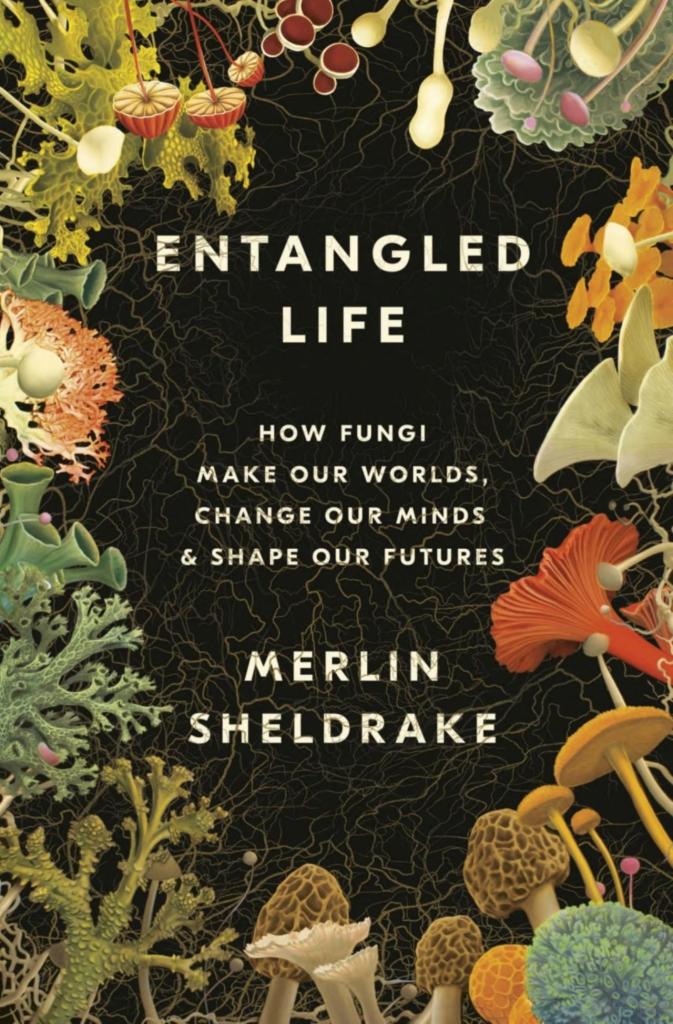
Entangled Life by Merlin Sheldrake, 2020, Penguin Random House.
Merlin Sheldrake’s highly readable book about the remarkable biology of fungi changes our view of evolution by showing how all living things – including humans – are ‘entangled.’
Pity the poor male cicada. When the fungus Massospora infects it, it seizes control of the animal’s central nervous system by injecting it with a cocktail of amphetamine and psilocybin, arousing the bug to a state of hyperactive horniness in which it soars through the air futilely signaling its genitals to release their seed. ‘Futilely’ because the cicada no longer actually has genitals. The fungus has absorbed them, along with the rest of the contents in the rear half of the insect’s body and filled the space with fungal spores. The cicada has become a “flying saltshaker of death,” (p.104) a zombified, spore distribution drone fully under the control of Massospora’s chemical wizardry.
Or consider the carpenter ant. When infected by the fungus Ophiocordyceps Unilateralis, the ant climbs up a nearby plant, which it would never normally do, walks to the edge of a leaf, locks onto it with its powerful jaws and lets its body dangle in the air. The fungus then digests the ant’s body from within and extrudes a spore-producing stalk out of its head which rains Ophiocordyceps spores down on other ants.
The point of these and other intriguing, if occasionally unsettling, bio-factoids that liven the narrative in Merlin Sheldrake’s Entangled Life, is to demonstrate that when it comes to evolutionary virtuosity, organisms with brains and muscles are often just props in someone else’s play.
Sheldrake isn’t suggesting that us members of the animal kingdom are somehow lesser beings than those in the fungal kingdom. He’s saying that fungi are experts of biological manipulation and integration. Sometimes (most of the time, it appears) they interact symbiotically with other species, to the mutual benefit of both symbionts; but sometimes, as with cicadas and carpenter ants, maybe not so mutually beneficial.
But Sheldrake has more than fungi on his mind. The real story he’s trying to tell is how the remarkable diversity of fungal interactions with other species illustrates the ubiquity of symbiosis in nature, and how this new understanding adds to our evolving view of how evolution really works. Just about every organism on the planet, including us, is a progeny of past symbiosis and has symbiotic entanglements with other organisms. Fungi just happen to be sublimely adept at it.
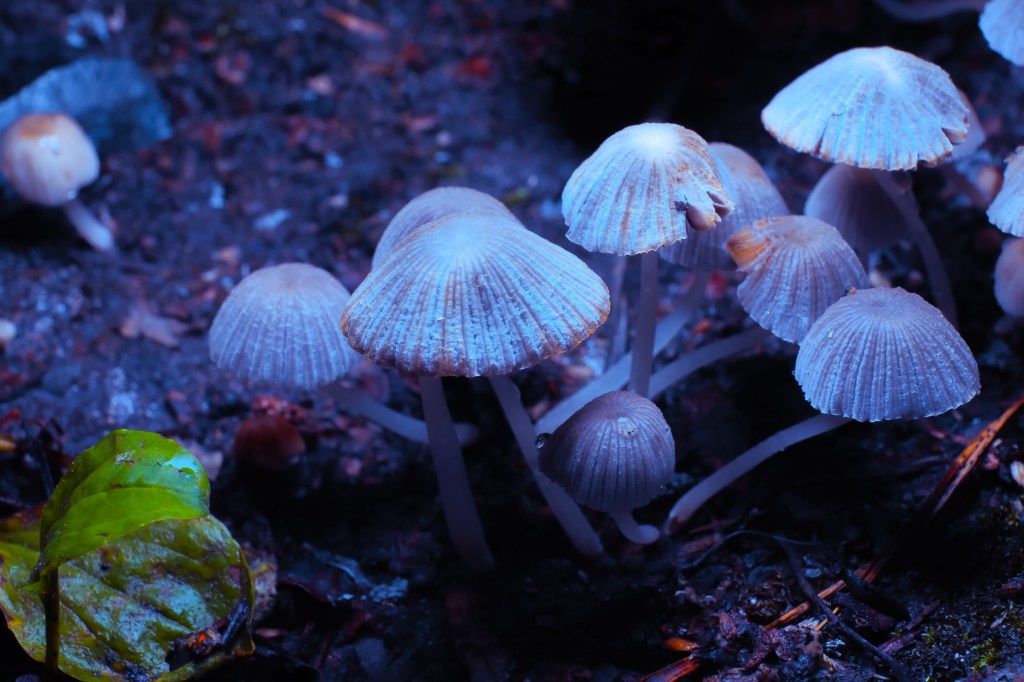
Toadstool psilocybin mushrooms under ultraviolet light. (Dmytri Steshenko, Shutterstock)
We learn, for example, that a single mycelial network beneath a forest in the American northwest, such as Armillaria, (p.172) can weigh many thousands of tons, stretch for miles, and be thousands of years old. One mycelial network can connect with others, and all of them, through their amazing genetic virtuosity, can rapidly produce the precise biochemicals necessary to interact symbiotically with the many millions of plants of the many thousands of different species in the soil above.
Plants plugged into a mycelial network appear to be able to signal each other about threats and opportunities, among other things. No one’s quite sure how this happens, but it’s known that mycelium can transmit electrical impulses along their cell membranes in a way that’s somewhat similar to action potentials moving through neural networks in animal brains. Unfortunately, we don’t yet know how fungi might be using this transmissive capacity because, Sheldrake tells us, mycology has always been the poor stepchild of the biological sciences when it comes to research funding, so only a handful of stalwarts are pursuing this intriguing phenomenon. But it raises the prospect of mycelial computing, i.e., not replacing computers with fungi (although that’s an interesting idea) but using mycelial networks to monitor the health and diversity of an ecosystem.
Sheldrake brings the conversation closer to home with his elaborations on the many human uses of fungi, from exotic truffles worth their weight in gold to miracle medicines that heal our infections and ease our pains, both physical and psychic. Sheldrake reminds us that the urge to use hallucinogens to explore the inner dimensions of the human mind didn’t start in 1960s America. He suggests that the antiquity of the urge is on full display in the neolithic cave paintings that depicted invisible worlds of gods and animal spirits. Pouches carried by ancient humans who were found frozen in ice, and the fossilized scatterings of even more ancient neanderthals buried under layers of rock, often contain fungi that they used for food, medicine, and tinder. And since these neolithic hunters were so adept at their own version of mycology, it’s not a great leap to suggest that they were also familiar with psychoactive mushrooms.
Psilocybin-producing mushrooms (there are 266 species of them) have “found themselves entangled with human life,” says Sheldrake. (p.95) What do humans do for them? Well, we grow them, and if their therapeutic value gains wider acceptance we might greatly increase their population. So, there’s that. What do they do for us? In Sheldrake’s view, “they soften the rigid habits of the mind … with which we organize reality,” which not only lets us see things differently, (pp.95&111) but can also help us deal with depression, addiction, and “existential distress” at having a terminal diagnosis. (p.95).
Sheldrake ponders a suggestion made by others that psilocybin mushrooms may have helped the modern human mind emerge from “the darkness of the hominid mind.” (pp. 101, 172) He’s too good a scientist to embrace such a theory outright. There’s only circumstantial evidence (ancient psilocybin mushrooms and ancient humans happened to be in the same place at the same time), and other scientists who study human evolution, not fungi, might have other ideas. He also hedges on whether psilocybin reveals inner truths … or hallucinatory ramblings. He explains how his own experience with LSD helped him perceive the world from a more fungi-centric perspective, thus making him more open-minded and insightful about his own scientific work. But he adds that this largely happened by the effect on his imagination.
I agree with his claim that scientific thinking always requires a bit of imagination, even though scientists don’t like to admit it. Physicists and chemists imagine molecular models which they know are only conceptual. Biologists imagine long strands of perfectly neat and helical DNA, and bean-shaped cells with transparent membranes, none of which actually exist in nature. Etc., etc. We can only see what our mammalian equipment allows us to see, so we can’t actually perceive the world the way another organism perceives it, Sheldrake reminds us. But an imagined world that’s highly informed by scientific insight can bring us closer to the truth about what’s really there or, in this case, how a mycelial network with no brain might ‘perceive’ the world. And so, if a hallucinogen makes our imaginations more flexible and dynamic, where’s the harm?

Colonies of mold fungi ascomycetes on rotten organic matter, (Oleg Kovtun Hydrobio, Shutterstock)
These lively philosophical musings remind me of his dad. Biologists of a certain age will remember Rupert Sheldrake, who proposed the biological theory of morphic resonance which suggested, among other things, that members of the same species can instantaneously exchange information with each other in a kind of sub-cognitive, holistic way, which, I guess, is something akin to quantum entanglement. I loved the speculation, but I never fully took the leap between what the evidence was saying and what Rupert was saying. Regardless, Rupert Sheldrake is a brilliant man and a courageous writer. But I think his son surpasses him here with the nimbleness of his writing and the discernment of his insights. I like his version of biological entanglement better than his dad’s.
He manages to write about lichen in a way that makes them fascinating to us non-lichenologists, which is a pretty neat trick. On the macro level, lichen are symbiotic dualities of mineral-absorbing fungi and sunlight-absorbing cyanobacteria. On the micro level, they’re suffused with many other organisms – protozoans, viruses – all exchanging genes horizontally and coexisting in symbiotic harmony. Lichens were the first multicellular organisms to emerge from the ancient sea, and they eventually provided the nutrients and anchorage that allowed plants to migrate onto land. Lichens are virtually everywhere. They can transform landscapes and restore damaged ecosystems. They’re hugely significant, yet their multi-species corpus makes them oddities within the artificial, species-centric framework that shapes our imaginings of how biology is supposed to work. They confound our idea that an ‘organism’ consists of a single, reproductively coherent unit. The lines blur and a new picture slowly forms.
The symbiotic view of evolution that emerges from Sheldrake’s book reveals it to be infinitely more interdependent and malleable – more entangled – than the neo-Darwinian ‘modern synthesis’ model that’s slowly fading into 20th century history. It’s a view that needs a much wider audience.
 Biology for the Soul