I considered calling this blog “Science for Catholics,” which I’ll explain shortly, but I’ll first explain, if it isn’t obvious, that this site is for those who like seeing the world from a biologist’s perspective.
It has bilateral morphology.
One side is some loosely organized drafts I’m accumulating for a book about the remarkable new 21st century view of evolution. My working title for the book is “Goodbye Darwin: How the new evolution changes everything,” but I suspect I’ll come up with something else before I get around to publishing it.
The other side of the blog has some of reviews of some recently published biology-themed books that I particularly liked. I’ve also included a few commentaries on recent research papers about the molecular biology of evolution and biological philosophy.
Before I go any further, for the express purpose of illuminating the narrative with some lovely pictures of my homestate, I’ll also mention that I live in Vermont.
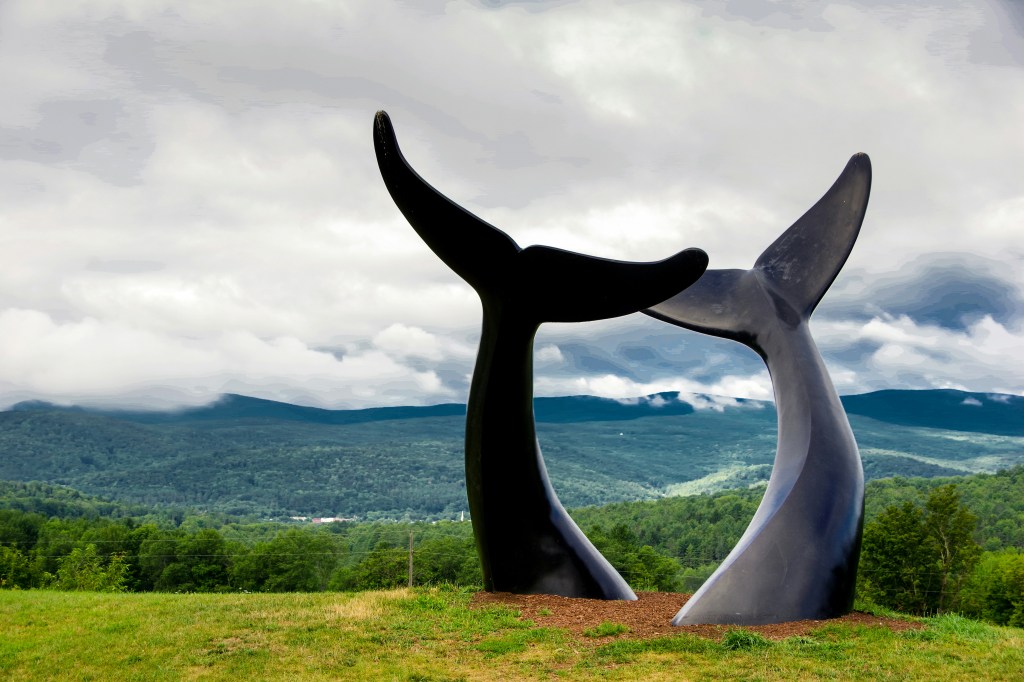
Wales Tales sculpture, Randolph, Vermont.
Stephen Mease, Unsplash
So, who am I and why am I doing this? I’m a science journalist. I was a laboratory biochemist for many years until I realized I liked writing much more than lab work. I left research to see what I could do, taking whatever writing or editing or publishing jobs came my way. Which is how I’ve come to know a good science story when I see it – and the revolution that’s occurring in evolutionary theory is a great story.
In simple terms, we’ve learned that Jean-Baptiste Pierre Antoine de Monet, chevalier de Lamarck (hereafter referred to as “Lamarck”) a French naturalist and philosopher who predated Darwin by 40 years, got something kind of right about evolution that Darwin got kind of wrong. But because Darwin was right about so much else, and because his theoretical ideas about inheritance and natural selection aligned with mainstream scientific thinking of the time, he became the founding father of western biology, while poor Lamarck was consigned to the back bench.
If you’re a science history nerd, it was somewhat like Galileo and Tycho Brahe.
What did Lamarck get right and Darwin not so much? Both men believed that all species on the planet right now evolved from other species. We couldn’t see it because is happened on a timescale very different from human time. But Darwin believed this happened as a result of spontaneous mutations that occured in the genetic-inheritance process. (This was long before anything was known about cell biology or molecular genetics.) If the mutation caused a change that was beneficial and helped the organism adapt more proficiently, then it gradually became amplified and normalized. When enough changes happened, voila – a new species arises.
Darwin wasn’t entirely wrong, but it turns out that random gene mutation is just one of the driving forces behind evolution, and probably not the most important one.
Lamarck believed organisms continuously adapted to their environments, and they passed these adaptations to their offspring. At some point, the cummulative adaptations amounted to a new species. Why this general concept was banished from western science for the last two centuries is an interesting story for another time. The main point is that mainstream biology is gradually realizing that not only was Lamarck generally right about this, (he was wrong about other things) but for most of nature, stimulus-response interactions between an organism and its environment play a much bigger role in genetic change than random gene mutation. The kinds of species-changing variations that are “selected” by nature, which Darwin believed were caused by random mutations in the genome, are actually brought about by real-time interactions between an organism and its environment.
All cells, whether they exist as single cell procaryotes (like bacteria) or within multicell eukaryotes (like us), have exquisitely complex and integrated biochemical matrices for reading and controlling their genomes. This matrix of regulation and replication, made up of hundreds of millions of interactive biomolecules, is the living force within the cell. The genome is an exquisite memory tape that weaves its way through it but nothing more. On its own, a genome is capable of nothing.
The matrix is exquisitely tuned to interact with the environment beyond the cell. It manages environmental threats and opportunities with proportional and complimentary changes in genomic protein synthesis. To achieve this, it manipulates and revises its genome in a way that may ultimately prove to be too complex for us to fully understand.
There’s no clear, agreed-upon understanding of the relation between ongoing, routine changes in the genome and the kinds of changes that hallmark species change. Biology is notorious for its fuzzy boundaries and loose rules. From a philosophical point of view it’s important to understand that these environmentally-influenced genomic revisions can occur in the specialized germ cells in eukaryotic organisms that were once thought to be immune to genomic changes in order to preserve the “purity” of the genome.
Simply put: Environmentally-caused changes in an active genome can get passed along to subsequent generations of the genome, whether it’s in a single cell organism or a eukaryote.
If you haven’t spent a lot of time thinking about evolutionary theory, you might ask: What’s the big deal?
The big deal is that, holistically, the intricate and hugely complex molecular-biological system in the cell that reads and revises the genome, let’s call it the matrix for now and I promise not to post a picture of Keeanu Reeves, is most accurately understood as having an inherent cognition that emerges synergystically from the vast, complex interactions of its parts. This is where life emerges from organic chemical non-life.
We can look at a narrow aspect of its operations – how a particular “gene” is transcribed into a particular protein – but we must do so with the understanding that this is akin to taking the back off a Swiss watch and focusing only on a particular gear. Every piece of the operation is fully integrated with and affected by every other piece. Just as a mechanical measure of time emerges from the synchrony of a watch’s gears, “life” emerges from the synchrony of a cell’s genetic engineering, molecular-biological machinery; its regulatory-replicative matrix.
Monarch Butterfly on Vermont farm.
Stephen Mease, Unsplash
This is not new-age bio-mysticism. Nor is it a backdoor argument for creationism or intelligent design – although the cell’s genetic engineering machinery is “intelligently” responsive to environmental threats and opportunities. The mainstream thinking in molecular biology right now tells us that the mechanistic, gene-centric version of Darwin’s theory that dominated the biological sciences for many decades is fatally simplistic. Living systems can be analyzed for their components, but not comprehended. Biology is about emergent, intelligent, reflexive-responsive systems that can’t be reduced to or predicted by underlying chemical or physical mechanics.
By focusing on a gene-centric theory of evolution as a means of imposing mathematical logic and predictability on biological complexity, 20th century biologists missed the real story that was right in front of them. All organisms have evolved the ability to adapt themselves to their environments, which largely means adapting to other organisms. Competition happens, but it usually results in mutual adaptation. “Natural selection” is better understood as continuous integrated transformation. Cooperative, complimentary symbiosis is by far the prevailing theme. This is the secret essence and power of life.
Philosophers of science have only begun to ponder what this means.
For those who might not have technical familiarity with what I’m talking about, here’s a more grounded explanation.
When a sperm cell fertilizes an egg cell, the egg cell is already a living cell with all the bioengineering machinery needed to read and transcribe a genome. Fertilization by the sperm triggers the egg cell’s replicative machinery into action, and it is the machinery, not the genome, that “decides” how to read and decode the genome in relation to the real-time, ongoing environmental influences the cell is experiencing. It is the machinery that possesses all the interlocking and interacting nucleic acid and protein molecules the cell needs to transcribe and transmute the genome’s DNA code into the millions of protein molecules that a typical cell produces every second in order to sustain life.
Life can only come from something that’s already alive. An egg cell is a living organism; a genome is not.
Another example is viruses, which are typically just pieces of DNA or RNA wrapped in a protein shell … like miniature, free-floating genomes. Viruses can only reproduce by inserting themselves into cells and integrating with one or more components of a cell’s replicative machinery – which often involves being inserted into the cell’s genome.
Most biologists don’t consider viruses to be “alive.” They have no metabolism; they can’t reproduce; they can’t evolve on their own – the hallmark of life. Viruses only come alive when they’re genetic information is infused into the already living, molecular biological system within a cell.
There’s much more to say about how life emerges from a cell’s molecular biological loom that I’ll get to in my blog. For now, I’ll explain a bit more why I’m writing about all this.
A relevant thing that’s worth mentioning is that my first encounter with evolution was many years ago at Catholic high school. I remember being surprised and fascinated by this scientific explanation about how we came to be, but not much else. It was a long time ago. The reason this is relevant is because I distinctly recall not having any kind of a philosophical-theological discussion about it. Nothing about the Bible or creationism or Catholicism or Darwinism, etc., etc. Just the straight up science. This was most likely because our curriculum was designed by Jesuits.
If you’re a Catholic, you can skip ahead to the next paragraph. If you’re not a Catholic, I’ll explain that Jesuits are an order of Roman Catholic priests who tend to be academically inclined and politically progressive. Sometimes it gets them into trouble. Jesuit Father Daniel Berrigan was a famous anti-war activist in the 1960s and 70s who made it onto the FBI’s most wanted list. Jesuits are the left wing of the Vatican which, by the way, formally accepted evolution as “correct science” back in the 1960s. One of the 20th century’s great mystics and visionaries about the spiritual meaning of human evolution was anthropologist and Jesuit scholar Pierre Teilhard de Chardin. The current Pope Leo (Augustinian) has embraced the cause of the late Pope Francis (Jesuit) who pronounced that humanity has a sacred duty to protect the earth because, after all, it’s God’s creation. Francis also said that Catholics in particular, because we know better, had a special responsibility to care for the poor and marginalized who’ve been impacted by climate change. The Vatican also has an official astronomer which, I’m guessing, is a reverberative mea culpa from the Middle Ages after all that nasty Galileo business. Big misunderstanding, right? The current astronomer, Richard Anthony D’Souza, holds a doctorate from the Max Planck Institute for Astrophysics and has published widely about the phenomenon of merging galaxies. And also – you guessed it – he’s a Jesuit.
This is an elaborate way of explaining how I left high school as a firm believer in evolution but also as a reasonably compliant but skeptical Catholic. I’d been infused with a streak of the Jesuitical capacity to be perfectly comfortable carrying two competing narratives about existence, God, and the universe in my head.
Today, I wholeheartedly believe the science behind evolutionary theory, but I’ve also experienced how profoundly the theory itself can evolve in less than a lifetime. The 20th century version of evolution presumed that the breathtaking complexity of the living world could eventually be broken down into simple, algorithmic concepts. The 21st century version of evolution says not only is that idea ridiculous, but the globally integrated complexity of life on earth may ultimately be beyond human comprehension. You don’t need to believe in God. That’s fine. But you very much should believe there’s an inherent cognition and agency in nature, born from its complexity, that’s beyond our rational understanding.
Which is why I half-jokingly wanted to call this blog Science for Catholics.
Why isn’t there more public awareness of all this? Well, evolutionary biology isn’t exactly a hot topic in the public media. If the new view of evolution had been born from some eureka moment, some sudden discovery turning everything on its head, then perhaps there’d be more social-cultural awareness. But that’s not what happened. The revolution occurred in slow motion, over decades stretching nebulously back to the 1970s and culminating at the beginning of the new century, with the decoding of the human genome.
But a bigger reason is that the scientific cognoscenti who study evolution all still seem a bit gob smacked about it, which I understand. It’s like they crossed the Adirondacks thinking they’d find the promised land, only to be suddenly facing the Rockies, with the Himalayas in the far distance. We now understand that evolution is deeply rooted in the labyrinth of molecular biology, and there are not many scientists with the experience, insight, and patience to guide someone along the most enlightening path through it. My modest task is to try to broaden the path a bit more without doing too much damage to the science, for which, if it happens, I take full responsibility.
More about my credentials: I studied biology in college with a focus on vertebrate evolution which, within the standard 20th century undergraduate curriculum, meant mostly taking courses in chemistry, physics, and math because, as we all deeply believed at the time, everything was reducible to chemistry, physics, and math, right? You needed to get your philosophy straight before you could do anything.
Besides all the theoretical stuff, one of the things I discovered in college (after spending a lot of time in one kind of lab or another. In my herpetology lab the professor would release his boa constrictor and tegu lizard to roam the benches as we tinkered with ancient turtle skulls; in organic chemistry class I figured out how to fine tune a gas chromatograph) was that I really loved the exotic machines and clever chemistry that you encountered in life sciences work. At the time this sort of hands-on work excited me. And I had good hands. I worked as a lab tech for several years after college and then got a master’s degree in biochemistry which gave me bench scientist status at a pharmaceutical company.

Blue Heron in Vermont pond
Asha Taylor, Unsplash
The work sustained me, but I could never fully embrace the medical research state of mind because it just felt so far from what had fascinated me about biology in the first place. How did this magical natural world that produced us come to be? How does this all happen, this brilliance?
Life isn’t that long. I wanted to somehow get back to thinking and learning about evolution. Focusing most of my time and cognitive energy on unraveling the chemical conformation of a protein hormone receptor might reveal some broader philosophical truths about how this magical universe works … but it didn’t seem likely.
And so, I eventually left bioresearch to have a different life that would give me more time to learn and read and write about the things that interested me and spoke to my soul.
And so, there you are. Biology for the Soul.
Some Books About the New Evolution
While there are many good books about the new paradigm of inheritance and evolution, one of the most comprehensive is: Evolution in Four Dimensions by Eva Jablonka and Marion J. Lamb, revised edition, 2014, MIT press.
For a livelier, more succinct description: Dance to the Tune of Life by Denis Noble, 2017, Cambridge University Press.
For a convincingly argued case for why biology is not reducible to math and physics: A World Beyond Physics – The Emergence and Evolution of Life by Stuart A. Kauffman, 2019, Oxford University Press.
 Biology for the Soul